


 Back to News
The Best Arc Alternatives in 2026: 9 Browsers Compared Before Arc Shuts Down
Arc shuts down December 22, 2026. We compared Dia, Phi, Zen, Vivaldi, Brave, Helium, Orion, Ardia and Crest on who keeps them alive, Netflix and Arc import.
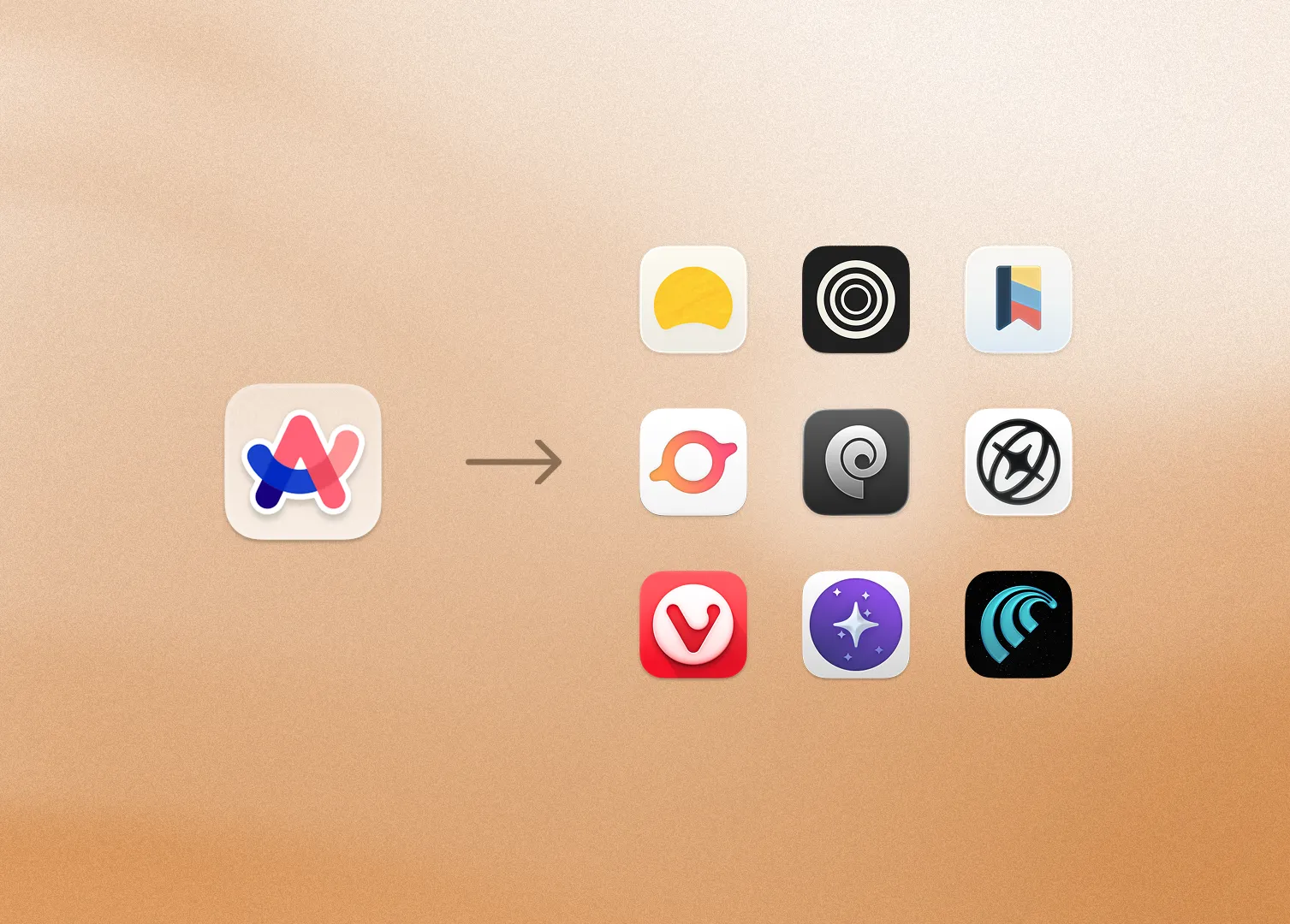
Short answer. For the easiest move, use Dia: it comes from Arc's own team and imports almost everything. For Arc's Spaces on a Mac, with Netflix, public source code and an AI you can switch off, use Phi. For a free, open-source browser on Mac, Windows or Linux, if you don't stream video in the browser, use Zen. For endless settings and no AI chatbot, use Vivaldi. Every fact below was checked on November 9, 2026, and links to its source.
A note before we start: we make Phi Browser. We hold it to the same tests as everyone else, and where a competitor does something better, we say so.
What happens to Arc, and when
The Browser Company announced on October 22, 2026 that Arc is being sunset. According to Arc's own farewell page:
| Date | What happens |
|---|---|
| October 22, 2026 | New Arc accounts can no longer be created. Existing accounts keep working. |
| November 23, 2026 | Arc Search on iOS and Android loses sign-in, sync and its AI features. |
| December 22, 2026 | Arc stops working on macOS and Windows. Accounts are deactivated and personal data is deleted within 30 days. |
The Browser Company's reason is security: "Keeping a browser secure takes constant, dedicated work that is only increasing in the age of AI." Its engineering and security teams now work on Dia. Until December 22, Arc "will receive basic updates."
That sentence is the most useful thing to carry into your search. A browser is never finished. It needs a new engine every few weeks, a fix within days when someone finds a hole, and a license deal before Netflix will play. Arc had a funded company doing that work and still ended. And the replacements are multiplying: a community-maintained list already tracks 39 browsers that carry on Arc's ideas (Awesome Arc Alternatives, November 9). Some of them are genuinely inventive. But the question Arc users learned the hard way is not "which one looks most like Arc?" It is "who will still be doing this work in 2028?"
How we judged them
We split the criteria into two groups. The first four ask whether a browser will last. The last four ask whether it will feel like Arc.
Will it last?
1. Who builds it, and who pays for it? A browser is expensive to keep alive. When Kagi stopped building Orion for Windows and Linux in October, it put it plainly: "Building a cross-platform browser is something usually done by companies backed by venture capital or by large open-source communities. Kagi is neither" (Kagi). For each browser we asked who does the work and where the money comes from.
2. If the maker stops, can anyone carry on? Arc's code was never public, so when The Browser Company stops, nobody else can pick it up. An open-source browser can be continued by others: Kagi is doing exactly that with Orion for Windows and Linux, handing the code to the community. A license alone doesn't keep a browser alive, though. Someone still has to do the engine updates. So we looked at both: is the code public, and is there a paid team behind it?
3. Does it keep up with security? Chrome now ships a new major version every two weeks: Chrome 154 on September 22, 155 on October 6, 156 on October 20 and 157 on November 3, 2026 (Chromium release schedule). Each one carries security fixes. A Chromium-based browser is only as safe as its last engine update, and a Firefox-based one depends on Firefox the same way. We counted public releases from April 1 to October 31, 2026, noted the engine each browser runs today, and looked at how each one handled its most recent security fix.
4. Is it finished software? Version labels are the developer's own honest signal. "Stable", "beta" and "early access" mean different things about bugs, data loss and security review. We report each browser's current label in its own words.
Will it feel like Arc?
5. Does Netflix play? Netflix, Spotify, Disney+ and Prime Video encrypt their video. Chromium and Firefox browsers play it with Google's Widevine. WebKit browsers, like Safari, use Apple's FairPlay instead. Widevine is not something a developer can simply switch on. Google licenses it to partners: Zen's FAQ says it is still "awaiting approval from Google" (Zen FAQ), and Helium's says everyone outside Google's partners has to go through third parties "who charge a ridiculous recurring fee for licensing" (Helium). Back in 2020, independent developer Samuel Maddock described Widevine rejecting his application outright (his blog). Arc played protected video, so this is usually the first thing a switcher notices.
6. How much of your Arc setup comes with you? "Imports bookmarks" is not "imports Arc." Arc kept most of its organization in Spaces, pinned tabs and folders. We checked which browsers bring Spaces across.
7. Does it still work like Arc? Vertical sidebar, Spaces, split view, Peek-style link previews, and some version of Air Traffic Control, the rules that send a link to the right Space.
8. Platforms, price and AI. People leave Arc for opposite reasons: some want more AI, some want none. A good replacement lets you choose.
The scorecard
Last checked: November 9, 2026. "Not documented" means we could not find the browser saying so publicly, not that the feature is missing.
Will it last?
| Browser | Who builds and funds it | Source code | Current label | Releases, Apr to Oct 2026 | Engine today | Latest security fix |
|---|---|---|---|---|---|---|
| Phi | Phinomenon Inc., a startup with nine open roles on its jobs page; free today, paid advanced features planned | Mac client public under Apache 2.0, and the download is built from it; engine build and AI servers not public | Stable (2.16.1) | 33, plus 2 so far in November | Chromium 156 with CVE fixes backported | 2.16.1 (Nov 6): issue reported by a security researcher fixed; Chromium CVE fixes backported |
| Dia | The Browser Company, owned by Atlassian | Not public | Stable (1.56.0) | Every Thursday | Chromium (version not published) | Not itemized in the changelog |
| Zen | Zen team, funded by donations and sponsors | Public (MPL-2.0) | Beta (1.24.1b) | 38 | Firefox 159.0.1 | 1.24.1b (Nov 5): "various security fixes" |
| Vivaldi | Vivaldi Technologies, employee-owned, Oslo | Partly: Chromium changes under BSD; interface code readable but not open-licensed | Stable (8.2) | 14 minor updates to 8.2; majors every few months | Chromium 152 Extended Stable, fixes backported from 156 | Rolling minor updates |
| Brave | Brave Software, Inc. | Public (MPL-2.0) | Stable | About weekly | Chromium 156 (Oct 28) | Weekly releases |
| Helium | imput, crowdfunded by its users | Public | Beta (0.20.x) | No dated list on its site | Chromium | Says it ships Chromium fixes "as soon as possible" |
| Orion | Kagi, "a handful of developers, funded entirely by Kagi users" | Mac and iOS not public; Windows and Linux code being handed to the community | Stable on Mac (1.1.3) | 9 on macOS | WebKit | Not itemized |
| Ardia | Independent open-source project on GitHub (mantrakp04); funding not stated | Public (GPL-3.0 as distributed; its own files Apache 2.0) | 0.2.44, plus a nightly it calls "wet paint" | Release notes list versions without dates | Chromium 156, Google services removed | Not itemized |
| Crest | One independent developer | Public (MPL-2.0) | Early access (0.8): "Security not independently audited" | Frequent stable and development builds | Ungoogled Chromium 155 | Not itemized |
| Arc (for reference) | The Browser Company | Not public | Basic updates until Dec 22 | n/a | Chromium | Ends Dec 22 |
Will it feel like Arc?
| Browser | Netflix and Spotify (DRM) | Arc import | Arc-style features | Platforms | Price and AI |
|---|---|---|---|---|---|
| Phi | Yes, Widevine since 2.13 (Oct 15) | Full migration of Profiles, Spaces and browsing data (since 2.9) | Spaces on top of Profiles, URL Rules, Peek, Split View | Mac (Apple silicon, macOS 14+); Windows in early access | Free; AI on by default, one switch turns it all off; browsing needs no account |
| Dia | Yes | Official: passwords, history, tabs, bookmarks, extensions; Spaces become Profiles | Sidebar tabs | Mac, Windows | Free; AI optional |
| Zen | No on Mac and Windows; waiting on a Widevine license | Spaces and Profiles from Arc and Dia (since 1.24b) | Workspaces, Glance, Split View, Space Routing | Mac, Windows, Linux | Free |
| Vivaldi | Yes, Widevine | Partial: extensions, passwords, history; not Spaces | Workspaces, Tab Stacks, split screen | Windows, Mac, Linux, Android, iOS | Free; no AI chatbot, by choice |
| Brave | Yes, Widevine (asks first) | Arc not listed as a source | Vertical tabs, tab groups; no Spaces | Windows, Mac, Linux, Android, iOS | Free; optional AI assistant (Leo) |
| Helium | No | Arc Spaces not documented | Vertical tabs, split view | Mac, Windows, Linux | Free |
| Orion | FairPlay (WebKit), not Widevine | Not documented | Vertical tabs | Mac, iPhone, iPad | Free; optional paid Orion+ |
| Ardia | Opens streaming sites in WebKit (FairPlay); Widevine in Chromium "waits on Google" | Arc spaces, pinned tabs and themes, plus bookmarks, history and passwords | Sidebar, split view up to three panes, command bar, profiles | Mac (Apple silicon, macOS 14+) | Free; no built-in AI chat, and a CLI lets your own agent drive it |
| Crest | Switches protected video to WebKit (FairPlay) | Spaces, tabs, folders, colors, icons, passwords | Spaces, Link Routing, Peek, Split View | Mac (macOS 26.1+), iPhone, iPad | Free |
Five patterns stand out.
Netflix follows the money. Every browser here that carries Widevine is built by a company with paid staff: Phi, Dia, Vivaldi and Brave. The two that can't play Netflix on a Mac at all, Zen and Helium, are community-funded, and both say the hold-up is Google's licensing. Ardia says the same about its Chromium side. Ardia, Orion and Crest get around it with WebKit's FairPlay, the way Safari does.
Public code and a paid team rarely come together. Zen, Helium, Ardia and Crest publish their code, but run on donations, crowdfunding, one person's time or funding they don't state. Dia and Orion on Mac have paid teams but keep their code closed, which is the position Arc was in. Three have both, to different degrees: Brave publishes its whole browser, Phi its Mac app but not its engine build, and Vivaldi its Chromium changes, while its interface code is readable but not open source.
The newest look-alikes are still early. Zen and Helium are labeled beta, Ardia is at 0.2 with a nightly it calls "wet paint," and Crest's own site says "Security not independently audited." Phi, Dia, Vivaldi, Brave and Orion ship stable releases. That is not a verdict on quality, but it is what each developer is telling you about bugs, data and security review.
Fast shipping is not only a company thing. Zen, a donation-funded project, shipped 38 releases in seven months, more than Phi's 33, and Dia ships every Thursday. Release pace tells you a browser is alive. It doesn't tell you who will pay for a Widevine license or answer a security report on a holiday.
Arc import has gotten good. Dia, Phi, Zen, Ardia and Crest all bring Arc Spaces across now. Vivaldi brings passwords, history and extensions but not Spaces, and Brave needs a bookmarks file.
The browsers, one by one
Phi Browser: Arc's Spaces on a Mac, with Netflix and public source code
Best for: Mac users who liked how Arc organized things and want Netflix, Chrome extensions and an optional AI in the same browser.
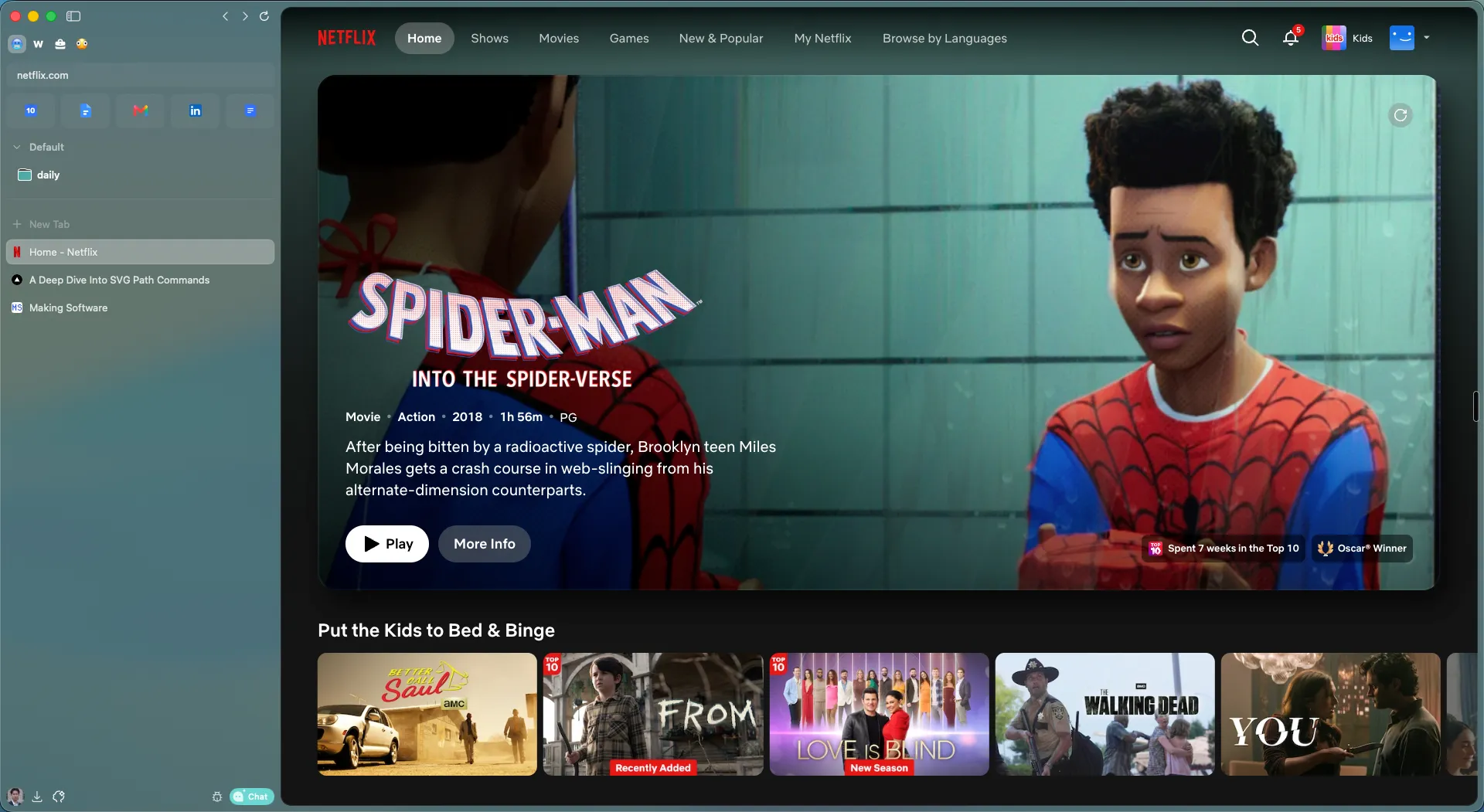
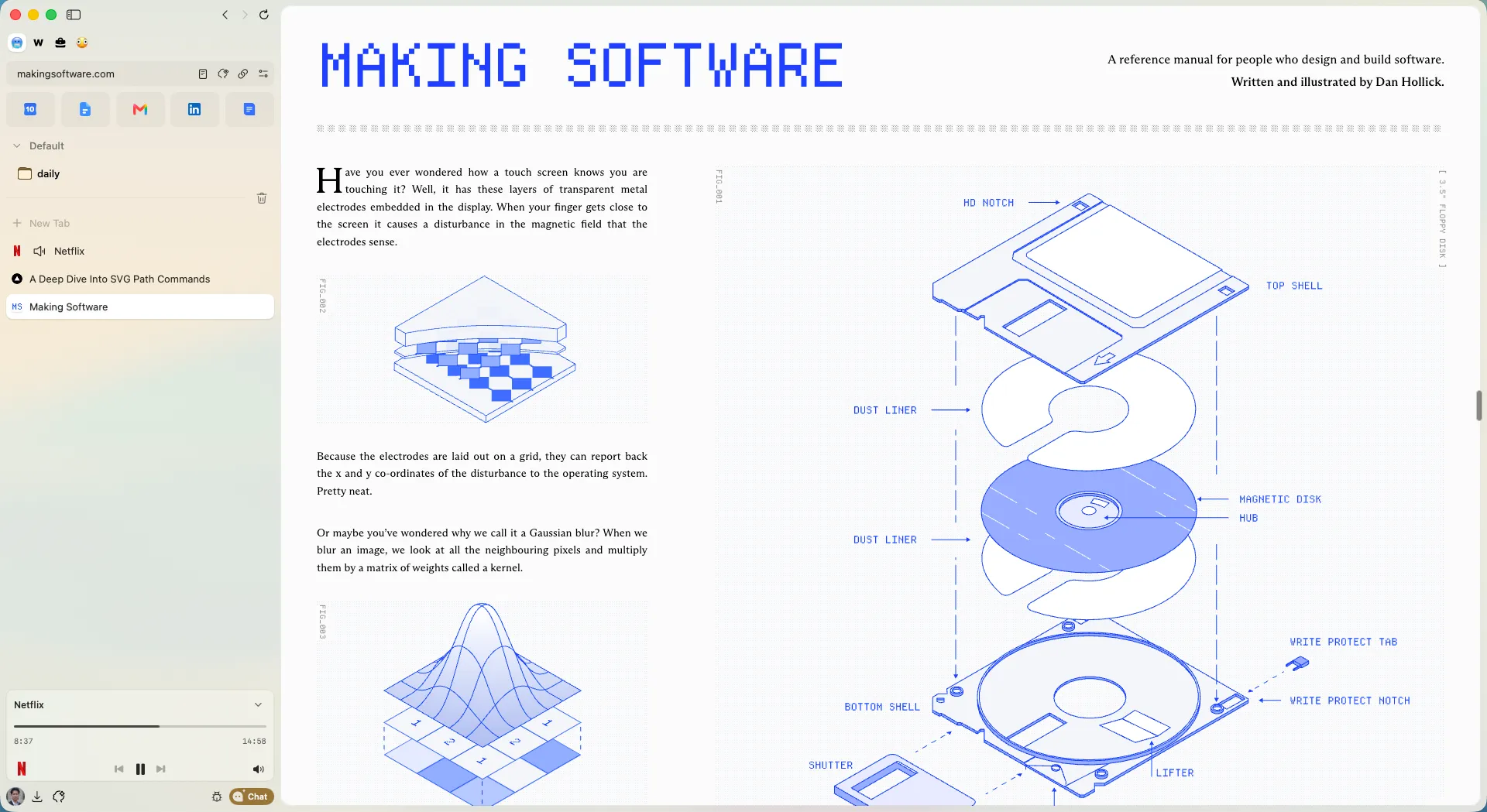
Phi is a native macOS app (AppKit and SwiftUI) on a Chromium engine, so Chrome extensions work. It keeps Arc's two-layer model: a Space is the workspace you see in the sidebar, and a Profile underneath holds cookies, logins and extensions, so several Spaces can share one signed-in session or stay fully separate (Switching to Phi). URL Rules are Phi's take on Air Traffic Control. There is also Peek, Split View, pinned tabs and a full bookmark tree.
On our criteria:
- Who builds it: Phinomenon Inc., which calls itself "a small independent software house" with no search business or ad network to answer to (GitHub README). Its jobs page lists nine open roles, including a security engineer, a Chromium C++ engineer and a test engineer for what it calls "a weekly-release macOS browser."
- Source code: the Mac client is public under Apache 2.0, and the README says the Phi you download "is built from this repository, from these commits," not from a mirror. The Chromium engine build and the AI servers are not public. Many of the changes in 2.16.0 came from GitHub issues.
- Security: 2.16.1 (November 6) fixed an issue a security researcher reported in a messaging integration and backported fixes for known Chromium CVEs.
- Release pace: 33 releases from April 1 to October 31, 2026, then 2.16.0 and 2.16.1 in the first week of November (release notes).
- Netflix: Widevine since 2.13 on October 15, 2026 (release note 2.13.0).
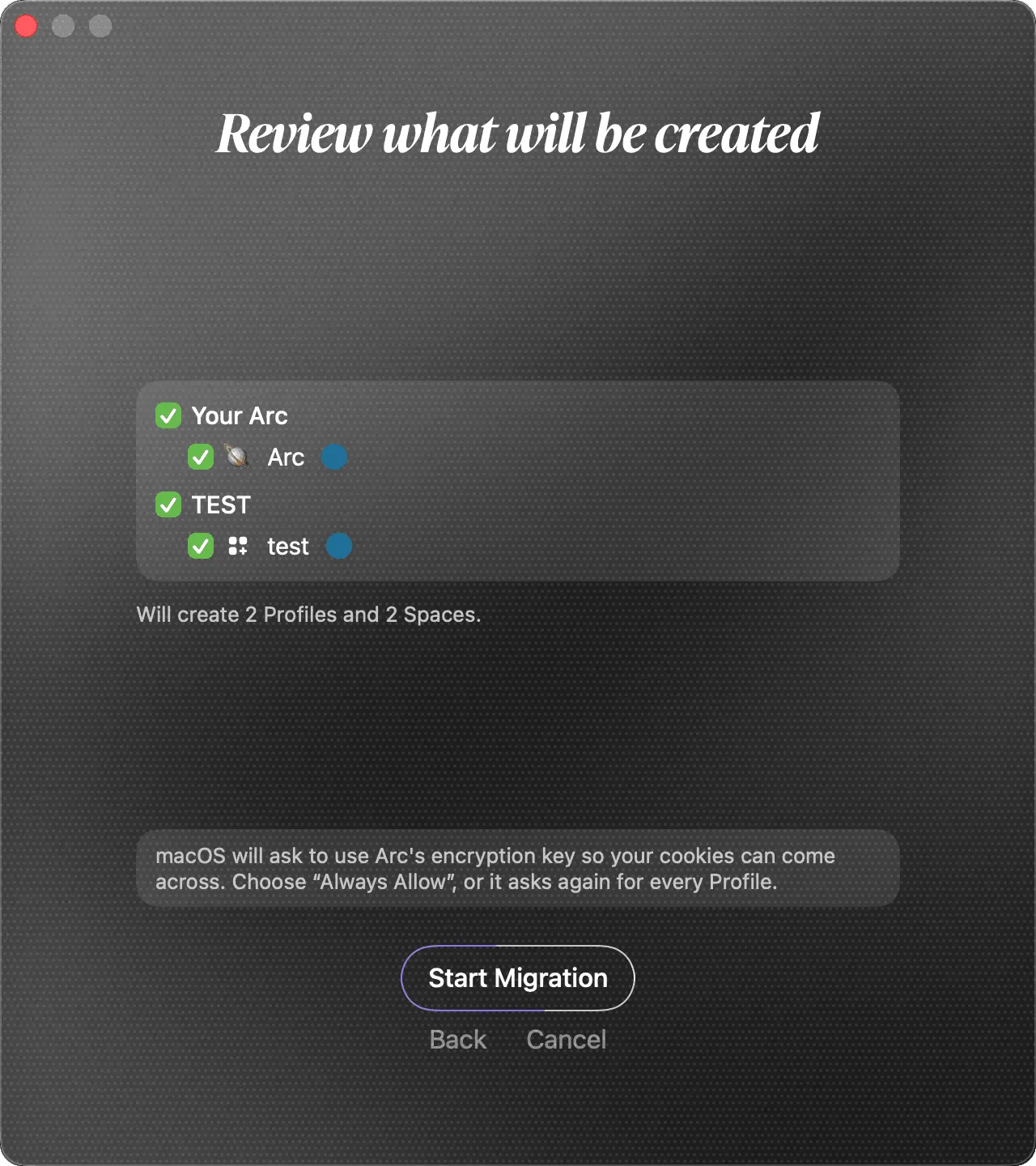
- Arc import: since 2.9, Phi migrates a whole Arc setup, including Profiles, Spaces and browsing data (release note 2.9.0). It also migrates from Zen.
- Account and AI: you can browse without an account. Signing in is only needed for AI features, Memory and sync (Getting started). AI is on by default, and one switch in Settings turns every AI feature off (FAQ).
Trade-offs: Mac only for now (Apple silicon, macOS 14 or later); a Windows build is in early access on GitHub and well behind. Phi is on Chromium 156 with security fixes backported, while Chrome moved to 157 on November 3. It is free today with AI usage included, and its FAQ says pricing "may be introduced for advanced features in the future."
Dia: the official successor, and the easiest move
Best for: people who want the least effort and are happy with a browser that is turning toward work tools.
Dia is built by Arc's team. It imports Arc's passwords, history, tabs, bookmarks and extensions in one step: Spaces arrive as Profiles, Folders as Tab Groups, and pinned tabs keep their names (arc.net). It is free on Mac and Windows, and The Browser Company says "the AI is optional."
Dia's release pace is the most regular here: a new version every Thursday, with 1.56.0 on November 5, 2026 (Dia changelog).
The thing to know is ownership. Atlassian bought The Browser Company in 2025 for $610 million (heise) and said its goal is "making Dia the knowledge worker's browser" (Atlassian). Recent releases add Atlassian sign-in and work-app connections. That is good news if your day lives in those tools. Dia's code is not public, so its future depends on Atlassian's plans, the same position Arc was in.
Zen: the best free, open-source option, if you don't stream
Best for: people who want an Arc-style sidebar on Mac, Windows or Linux, value open source, and watch Netflix in an app.
Zen is built on Firefox, with Workspaces, Compact Mode, Glance, Split View and Space Routing (zen-browser.app). Its team ships remarkably often: 38 releases between April and October, and 1.24.1b on November 5 runs Firefox 159.0.1 with "various security fixes" (Zen release notes). Since 1.24b it imports Spaces and Profiles from Arc and Dia.
The catch is streaming. Zen's FAQ says it "currently lacks DRM support" on Windows and macOS, so Netflix, Spotify, Disney+ and Prime Video won't play "for the foreseeable future," while it waits on Google's approval for a Widevine license (Zen FAQ). Zen is still labeled beta, uses Firefox add-ons rather than the Chrome Web Store, and is funded by donations and sponsors.
Vivaldi: the most configurable, with no AI chatbot by choice
Best for: people who loved tweaking Arc and would rather not have an AI chatbot in their browser.
Vivaldi has Workspaces, two-level Tab Stacks, split screen and Quick Commands (Vivaldi features), and it plays Widevine-protected video (Vivaldi Help). Its CEO, Jon von Tetzchner, wrote in 2025 that Vivaldi will not add "a chatbot, a summarization solution or a suggestion engine" until more rigorous ways to do those things exist (Vivaldi blog).
Vivaldi Technologies is employee-owned and based in Oslo, and has been shipping since 2016. Its code is partly open: changes to Chromium are published under BSD, and its interface is written in readable HTML, CSS and JavaScript but not under an open-source license (Vivaldi Help). The stable version runs on Chromium's Extended Stable branch (152) with security fixes backported (Vivaldi desktop blog).
Arc import is partial: extensions, passwords and history, but not Spaces or folders (Vivaldi forum). Expect to rebuild your Workspaces by hand.
Brave: privacy defaults on every platform
Best for: people who want built-in ad blocking and the same browser on every device, and don't need Spaces.
Brave runs on Chromium 156 (as of 1.98.62 on October 28, 2026) and ships about weekly (Brave release notes). It plays Widevine-protected video after asking you the first time a site needs it. Brave Software, Inc. was founded in 2015 and publishes its browser under MPL-2.0 (GitHub).
For Arc users, the gap is organization: vertical tabs, tab groups and Profiles, but no Spaces-style workspace switcher, and Brave's importer doesn't list Arc. Export your Arc bookmarks to an HTML file first.
Helium: minimal and private, streaming not yet
Best for: people who want a quiet, fast Chromium browser with no telemetry and can keep a second browser for Netflix.
Helium blocks ads and trackers by default, makes "zero web requests on first launch," supports Chromium extensions, and has vertical tabs and split view (helium.computer). It is open source, crowdfunded by its users, built by imput, and still in beta, with no sync or mobile app yet.
Helium does not support Widevine. Its FAQ says that is "not done by our choice, but because Google restricts Widevine licensing to its partners" (helium.computer); in late October its developer said support is coming "soon," with no date (PiunikaWeb).
Orion: WebKit speed and zero telemetry from Kagi
Best for: Mac and iPhone users who care more about battery life and privacy than about Arc-style Spaces.
Orion is built on WebKit, Safari's engine, supports many Chrome and Firefox extensions, promises zero telemetry, and has native vertical tabs (kagi.com/orion). Protected video goes through FairPlay, as in Safari.
Orion is made by Kagi, the paid search company, by "a very small team, just a handful of developers, funded entirely by Kagi users." In October Kagi stopped building Orion for Windows and Linux and is open-sourcing both "so the community can carry them forward," to focus on macOS and iOS (Kagi blog). On macOS it shipped nine releases from April to September, the latest 1.1.3 on September 28 (Orion release notes).
Ardia: Dia's look on de-Googled Chromium, still at 0.2
Best for: Mac users who want an Arc-style sidebar with Dia-like polish and uBlock Origin built in, and don't mind a 0.x version number.
Ardia describes itself as "Arc's sidebar and Dia's polish on real Chromium" (ardia.dev). It runs Chromium 156 with Google's background services removed, builds in the full uBlock Origin, keeps separate logins per profile, splits up to three panes, syncs through your own iCloud Drive, and imports Arc's spaces, pinned tabs and themes along with bookmarks, history and passwords (GitHub README). It is open source under GPL-3.0.
The trade-offs come with its age. Ardia is at version 0.2.44, with a nightly build its site calls "wet paint." Streaming sites open in a WebKit engine because, in its README's words, "Widevine in Chromium waits on Google." It is Mac only (Apple silicon, macOS 14+), and the project doesn't say who funds it.
Crest: the most faithful Arc clone, built by one person
Best for: Arc fans on the newest macOS who want Arc's exact vocabulary back and are comfortable with early-access software.
Crest is the closest match to Arc's feature list: Spaces stay Spaces, Air Traffic Control becomes Link Routing, and its import carries over Arc Spaces, tabs, folders, colors, icons and passwords (OpenSourceAlternatives listing). It syncs through iCloud across Mac, iPhone and iPad, and runs two engines: ungoogled Chromium by default, switching to WebKit for protected video (NewReleases).
The risks are the ones you'd expect from a young project by a single developer. Crest is at version 0.8, its own site says "Early access. Security not independently audited." (crestbrowser.com), and it requires macOS 26.1 or later on Apple silicon.
And the browsers you already have
If you just want something that will almost certainly still be here in five years, Safari, Chrome and Edge are fine. All three are on Netflix's supported list, and Safari streams Netflix in up to 4K on a Mac (Netflix). None of them feels like Arc out of the box.
Which Arc alternative should you pick?
- The easiest move, and you live in work tools: Dia.
- Arc's Spaces on a Mac, with Netflix, public source code and an AI you can turn off: Phi.
- Free and open source on Mac, Windows or Linux, no streaming in the browser: Zen.
- Maximum control and no AI chatbot: Vivaldi.
- Privacy defaults on every device: Brave.
- A minimal private browser, and you can wait for DRM: Helium.
- WebKit and battery life on Mac and iPhone: Orion.
- A young open-source Mac browser with Dia's look and uBlock Origin built in: Ardia.
- The most literal Arc clone, on macOS 26.1+: Crest.
How to leave Arc before December 22
- Pick now, not on December 21. Install two candidates and use each for a few days with your real tabs.
- Import while Arc still opens. Dia, Phi, Zen, Ardia and Crest can import from Arc. In Phi, open the Phi menu and choose Import from Another Browser (Phi help).
- Keep a backup. In Arc, go to Settings > Advanced > Export Data to save your Spaces and tabs as a list of links (arc.net).
- Move your passwords on purpose. Not every browser imports them, and a dedicated password manager makes the next move easier.
- Test the sites you can't live without. Streaming, banking, work apps. Do it before Arc stops opening.
Frequently asked questions
When does Arc stop working?
On December 22, 2026, on macOS and Windows. Accounts are deactivated that day and personal data is deleted within 30 days. New accounts have been closed since October 22 (arc.net).
What is the closest browser to Arc?
For the same team and the easiest import, Dia. For Arc's Spaces-on-top-of-Profiles model on a Mac, Phi. For the most literal clone, Crest, which is early-access software from one developer. On Windows and Linux, Zen is the closest free option.
Which Arc alternatives will still be around in a few years?
Nobody can promise that, and Arc is the proof. The signals worth checking are a paid team, a way to pay for the work, a stable release label, and public source code so others can continue if the maker stops. Of the nine here, Brave, Phi and Vivaldi have a paid team and publish at least part of their code; Brave publishes all of it. Dia and Orion have paid teams and closed code. Zen, Helium, Ardia and Crest publish their code but rely on donations, crowdfunding, a single developer or funding they don't state.
Which Arc alternatives can play Netflix?
Phi, Dia, Vivaldi and Brave play Widevine-protected video. Orion, Ardia and Crest use WebKit's FairPlay for it, like Safari. Zen (on Mac and Windows) and Helium can't play Widevine-protected video as of November 9, 2026.
Can I import my Arc Spaces?
Yes, into Dia (as Profiles), Phi, Zen (since 1.24b), Ardia and Crest. Vivaldi imports extensions, passwords and history but not Spaces, and Brave's importer doesn't list Arc.
Do I need an account to use Phi?
No. You can choose "Explore Phi without signing in" and browse normally. A Phi account is only needed for AI features, Memory and sync between Macs (Getting started).
Is there a free Arc alternative?
All nine are free to use. Orion has an optional paid tier (Orion+), and Phi says some advanced features may become paid later.
Is Dia better than Arc?
Dia is newer, ships every week and imports your Arc setup. Atlassian owns it now and is building it into a browser for knowledge workers, so it puts more weight on AI and work-app integrations than Arc did.
Why does Netflix not work in my new browser?
Usually because the browser doesn't have a Widevine license. Google licenses Widevine to selected partners, so small and open-source browsers often launch without it. Check the browser's FAQ for "DRM" or "Widevine" before you switch.
Sources
Checked November 9, 2026.
- Arc sunset timeline and Dia import: arc.net
- Netflix supported browsers: Netflix Help Center
- Chrome release dates: Chromium Dash schedule
- Community list of Arc alternatives: Awesome Arc Alternatives
- Widevine licensing for small browsers: Samuel Maddock, "The End of Indie Web Browsers"
- Phi: release notes, 2.9.0, 2.13.0, 2.16.0, 2.16.1, FAQ, Getting started, Switching to Phi, jobs, Mac client source
- Dia: changelog, Atlassian announcement, heise on the $610M deal
- Zen: FAQ, release notes, homepage
- Vivaldi: Widevine help, Is Vivaldi open source?, features, desktop blog, AI stance, Arc import answer
- Brave: release notes, DRM help
- Helium: homepage and FAQ, PiunikaWeb on DRM plans
- Orion: homepage, release notes, Kagi blog
- Ardia: ardia.dev, GitHub README
- Crest: crestbrowser.com, OpenSourceAlternatives listing, 0.8.50 release
Phi Browser is a native browser for macOS. If you are leaving Arc, download Phi and bring your Spaces with you before December 22.